Termite Architecture &
More-than-Human Building
Architecture is not subject to humans. The ways in which species build their homes and habitations is a didactic way of understanding how the structure itself relates to the Earth and to ‘systems’. Why did they use the material they used? How did they build this? How does the structure choreograph movement ‘to and from’? What systems amongst the community arise in negotiation with the structure?
As humans, there is something we can learn about how animals build their home—through slowing this process down to reveal the complexities there is a relationship between material, aesthetics, community and even government amongst the species.
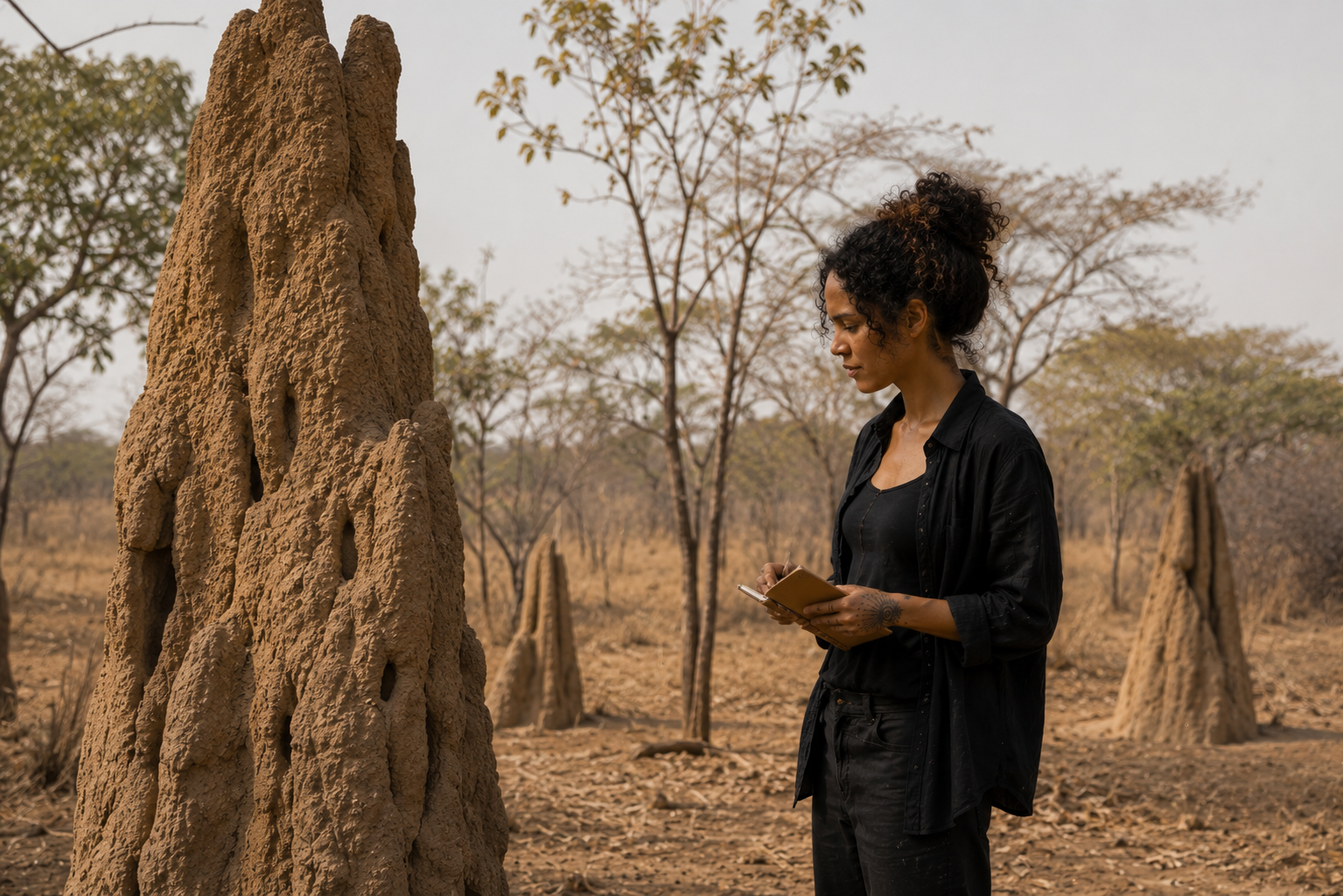
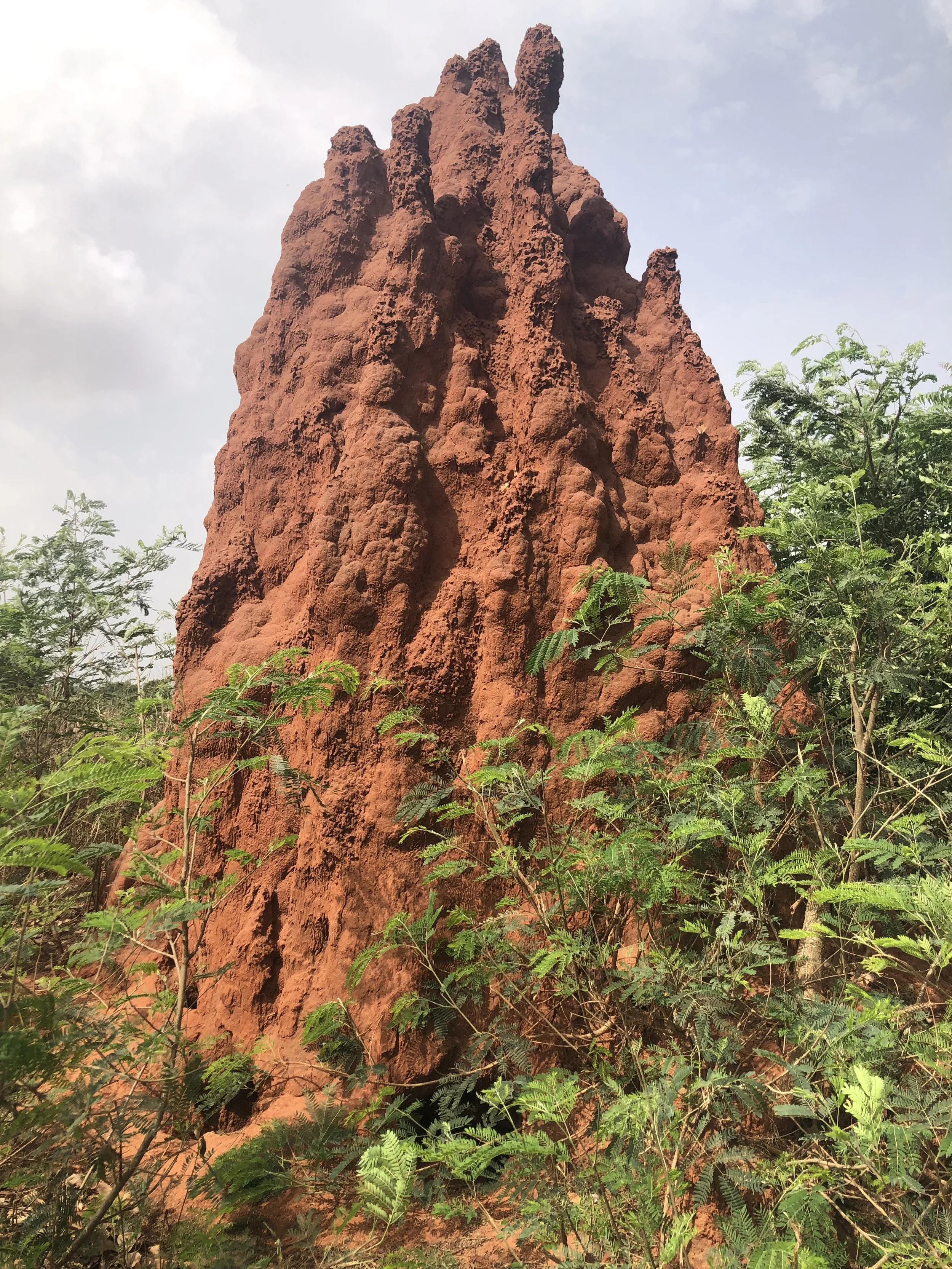
“It’s the fall of 2021 and I am travelling through Ghana, in a constructed route up the Volta river coast of sub-saharan Africa. There are termite mounds everywhere, and these earthly sky-rises have completely captivated my heart. These mounds proliferate throughout the landscape as if to be emerging as an extension of the landscape itself and I can’t help but think, “I must know the architect.”
- Dairy entry from 2021, Ghana
This observation has evolved into an ongoing research project on more-than-human building, beginning with termites.
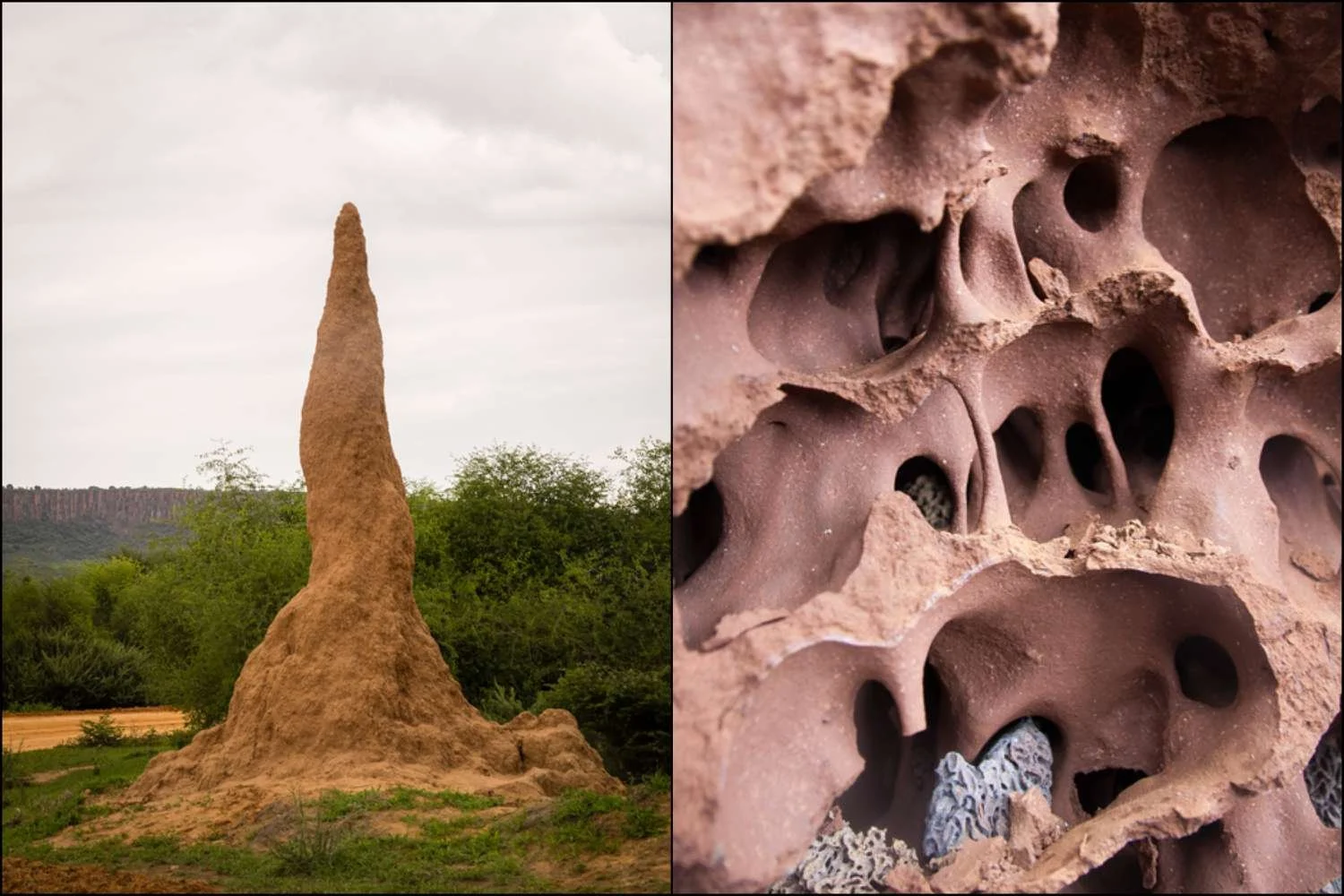
Termite mounds are often described as the skyscrapers of the desert. Acting as elaborate ventilation systems, they function as breathable lungs that ensure the survival of the colony. Yet the termites themselves do not inhabit the tower. Instead, they live within an extensive network of underground chambers that house their food stores, eggs and queen. The tower serves another purpose: maintenance, repair and defence. Otherwise, it remains a self-operating porous structure, breathing in and out with the desert winds.
What fascinates me is that the mound frequently outlives the colony that built it. These structures are so architecturally sophisticated that once abandoned, they can be occupied by entirely new species. Everything about the mound operates through circularity and interdependence. The termite gathers material from its environment—soil, wood and organic matter—transforms it into architecture, and eventually that architecture returns to the earth. Nothing is wasted. Nothing exists in isolation.
Contrary to popular belief, termites do not build alone. Their architecture depends upon collaboration with Termitomycesfungi, whose digestive processes break down woody fibres into forms that termites can then use as building material. The mound is therefore not the product of a single species, but of a multispecies alliance. It offers a powerful reminder that life emerges through divergence, convergence and cooperation.
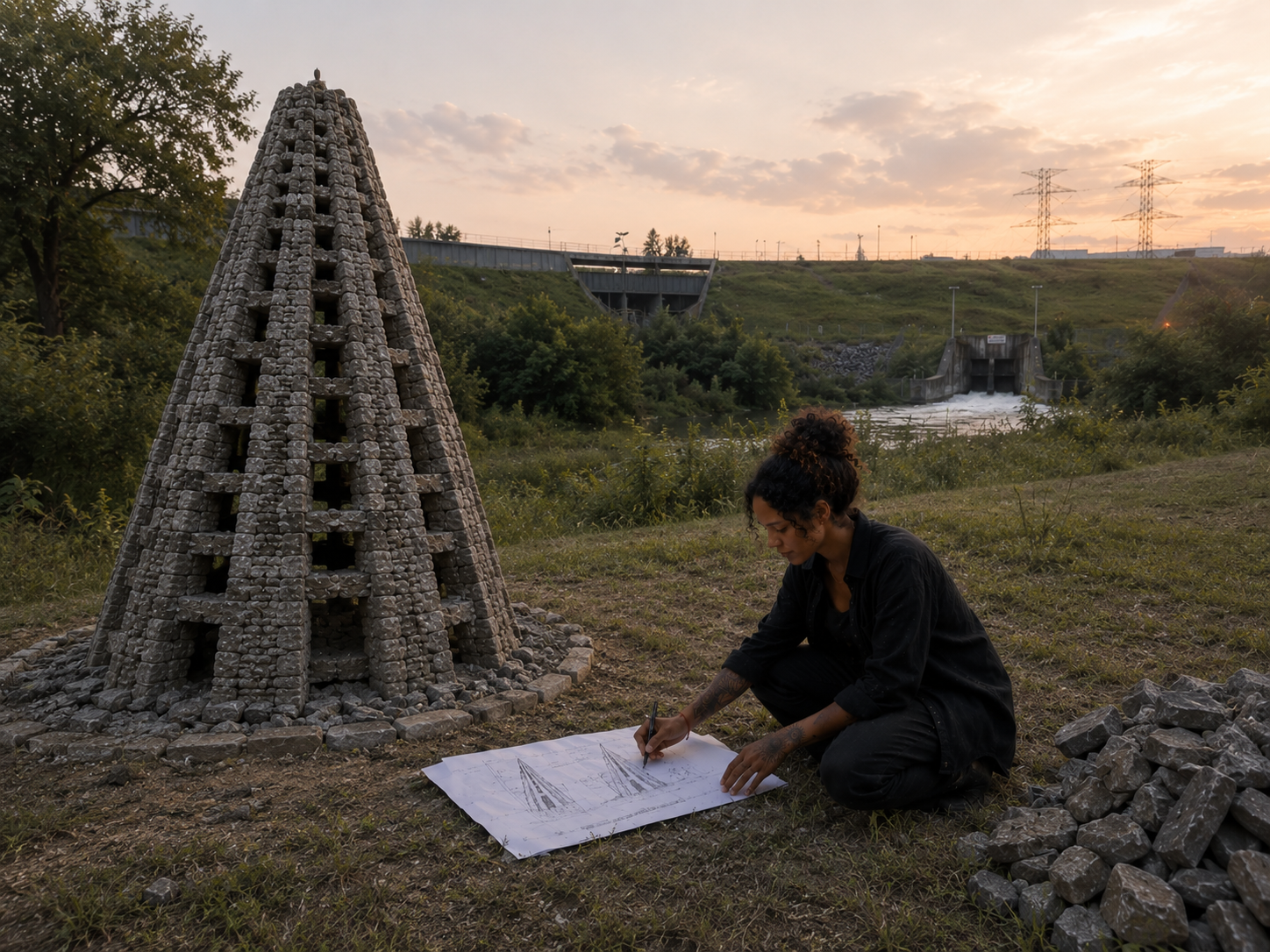
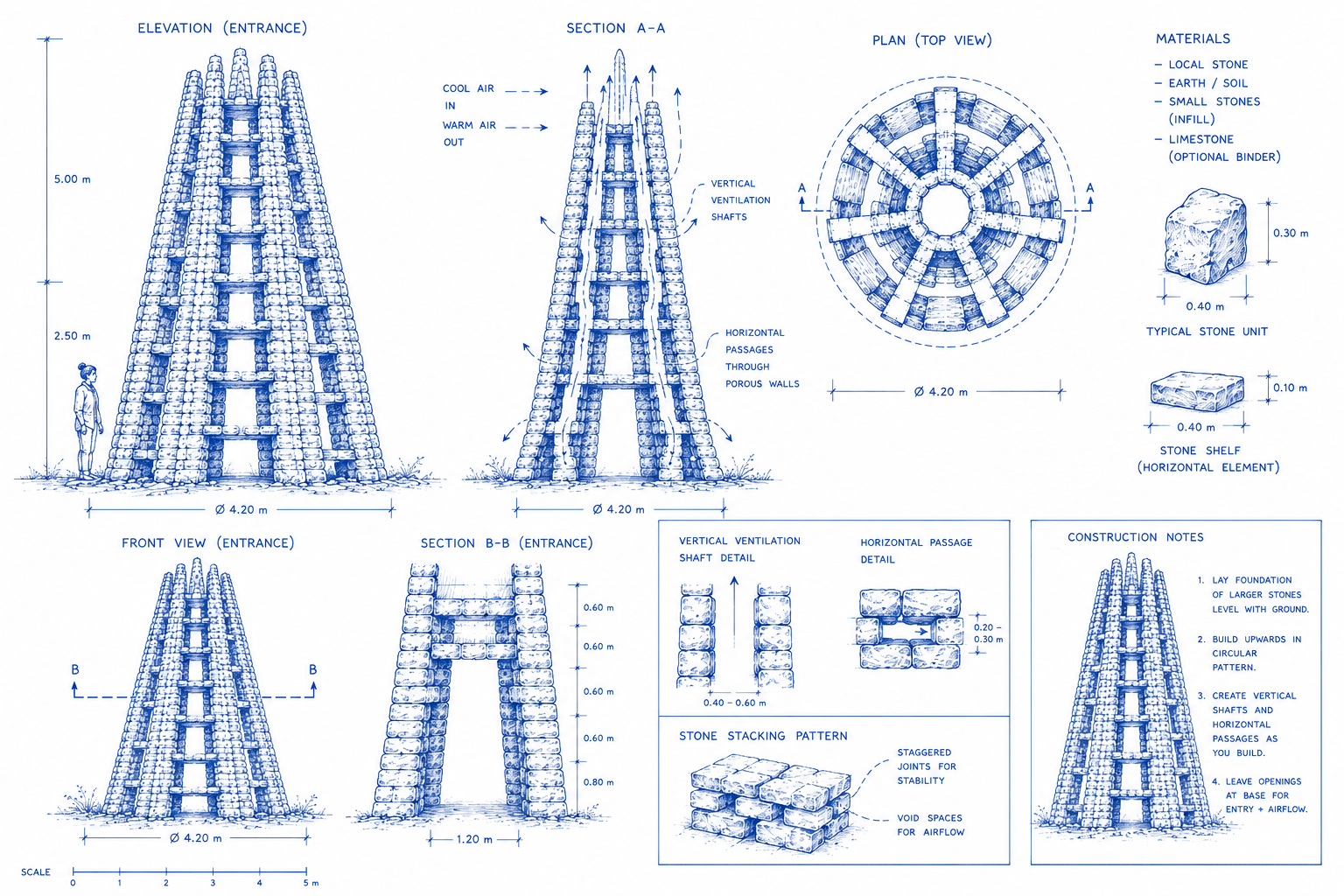
This research led me to consider what it might mean to design with a landscape rather than upon it. Inspired by the intelligence of termite mounds, I developed my own speculative structure using stones gathered along a river in Toronto. The project emerged through an embodied process of walking, listening and material engagement. Rather than beginning with a drawing, I began by moving through the site repeatedly, carrying stones, arranging them, and allowing the landscape itself to inform the design.
The work coincided with a period of grief. As I walked the riverbank, listening to the music of Alice Coltrane, the act of designing became inseparable from ritual. The stones became collaborators, the river a teacher, and movement a form of research. Through repeated encounters with the site, I gradually embedded myself within the landscape I was attempting to understand.
What the termites revealed was not simply a lesson in construction, but a lesson in relationship. Architecture need not be an act of mastery. It can instead emerge through attentiveness, reciprocity and deep listening to the human and more-than-human worlds that surround us.
As Anna Tsing writes:
“Making worlds is not limited to humans. We know that beavers reshape streams as they make dams, canals, and lodges; in fact all organisms make ecological living places, altering earth, air and water. Without the ability to make workable living arrangements, species would die out.”